Guide11 min read
5S in a Factory: Implementation Steps, Checklist and SOP
5S is Sort, Set in order, Shine, Standardise and Sustain. How to implement it on the shop floor, with a housekeeping checklist, daily SOP and audit scoring.
By Occulax team
On this page
- What is 5S in a factory?
- Why does housekeeping affect output and safety?
- How to implement 5S in a factory, step by step
- Checklist for housekeeping in a factory
- SOP for housekeeping in a factory
- How to score a 5S audit
- What should be on a 5S board?
- Checking housekeeping automatically with your existing cameras
- Frequently asked questions
Walk onto any shop floor and you can tell in a minute how well it runs. Blocked aisles, tools on the floor, oil patches and piles of unmarked material are not just untidy — they slow people down, hide problems and cause accidents. 5S is the simplest structured way to fix that, and it is usually the first lean method a plant puts in place. This guide covers what 5S means, how to implement it in a factory, a housekeeping checklist you can use, a daily and weekly SOP, and how to score a 5S audit.
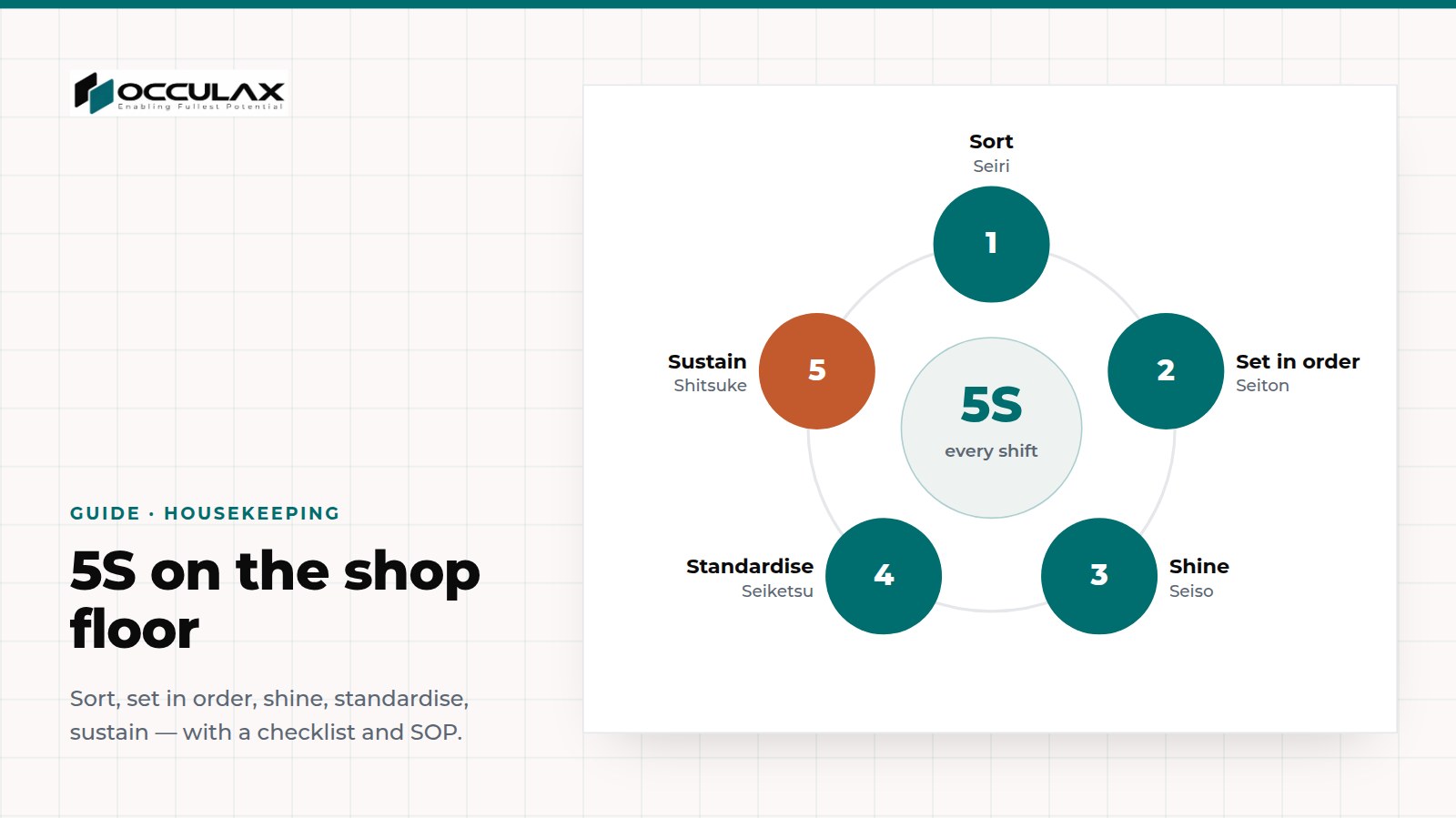
Quick answer 5S is a five-step method for workplace organisation: Sort (Seiri), Set in order (Seiton), Shine (Seiso), Standardise (Seiketsu) and Sustain (Shitsuke). To implement it, start with one pilot area, remove everything not needed, give every remaining item a marked place, clean and inspect, write the standard, and audit it every week with a simple score.
What is 5S in a factory?
5S comes from five Japanese words, each starting with "S". English versions also start with "S", which makes them easy to remember.
| Japanese | English | What it means on the shop floor |
|---|---|---|
| Seiri | Sort | Remove everything not needed in the area: old jigs, scrap, broken tools, extra material |
| Seiton | Set in order | A fixed, marked place for everything that stays, close to where it is used |
| Seiso | Shine | Clean the area and equipment, and use cleaning as a chance to inspect for leaks and damage |
| Seiketsu | Standardise | Write down how the area should look and who does what, so every shift does it the same way |
| Shitsuke | Sustain | Make it a habit through daily routines, regular audits and leadership attention |
The first three are actions. The last two are what stop the area sliding back to how it was. Most failed 5S programmes did the first three well, took photos, and stopped there.
Note Some plants add a sixth S for Safety and call it 6S. That is fine, but safety should be built into every one of the five steps, not treated as an extra.
Why does housekeeping affect output and safety?
Housekeeping is often seen as cosmetic. It is not. Poor housekeeping costs output in ways that are easy to miss:
- Searching: an operator who spends a few minutes per hour looking for a gauge, a spanner or the right bin is a machine standing idle.
- Blocked aisles: forklifts and trolleys wait or take long routes, material reaches the machine late, and people walk further.
- Hidden problems: oil leaks, loose guards and damaged cables are hard to see under dirt and clutter.
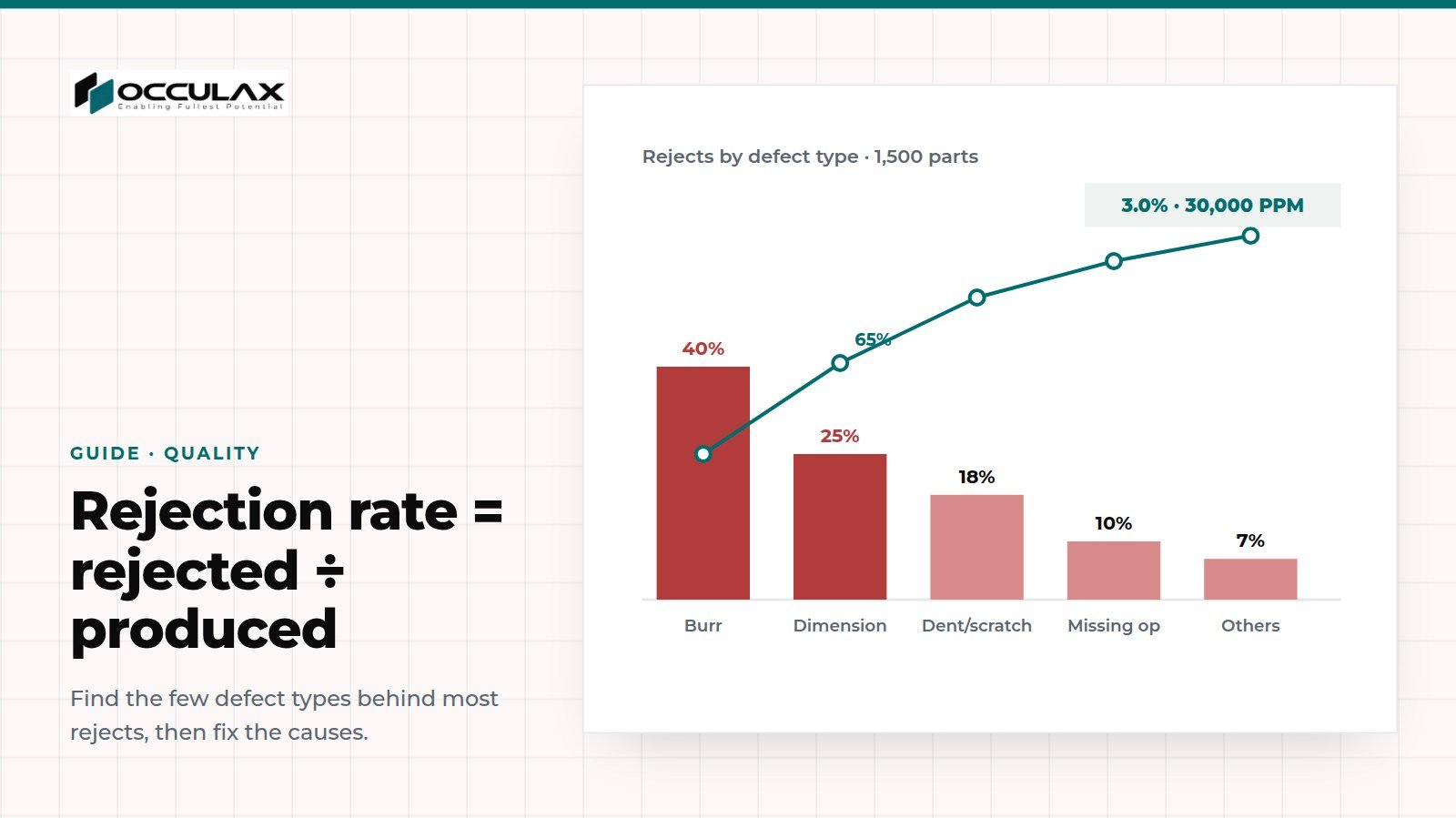
- Mixed material: unlabelled parts get used in the wrong job, which leads to rejection. See how to reduce rejection rate.
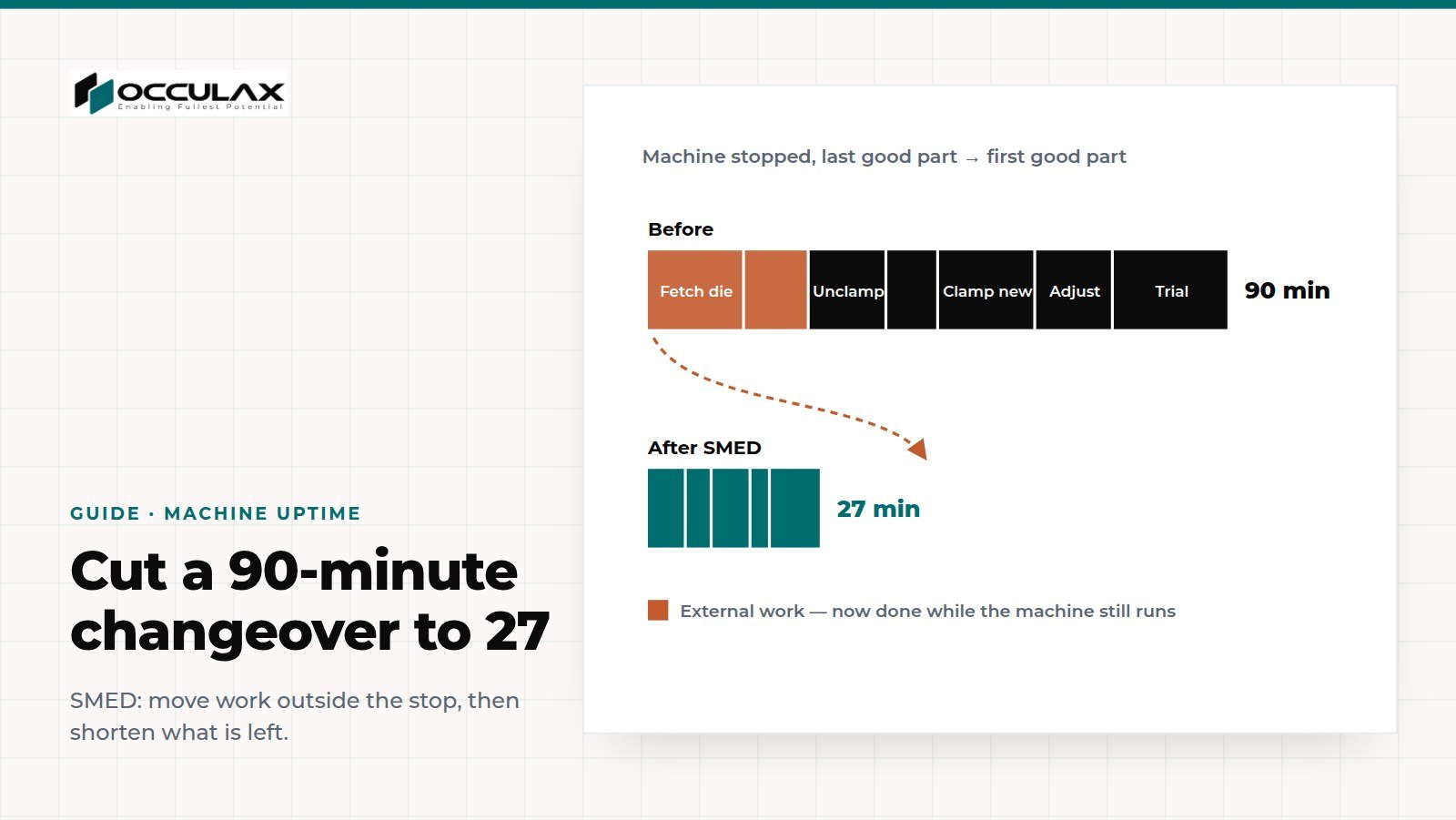
- Slow changeovers: if tools and dies are not where they should be, changeovers stretch. See how to reduce changeover time with SMED.
Safety is the other side. Slips on oil, trips over cables and pallets, and blocked fire exits and extinguishers are classic housekeeping failures. Indian factory law has long covered this: the Factories Act, 1948 includes duties on cleanliness (Section 11) and on keeping floors, stairs and passages free from obstructions (Section 32). Check the current rules that apply to your plant with your safety officer.
How to implement 5S in a factory, step by step
1. Pick a pilot area and a team
Choose one visible area — a machine cell, a store or an assembly line — not the whole plant. Form a small team of operators from that area, a supervisor and someone from maintenance. The people who work there must do the work; 5S done by an outside team does not last.
Take "before" photos from fixed spots so you can compare later.
2. Sort (Seiri): red-tag what is not needed
Go through everything in the area and ask: is this needed here, and how often? Put a red tag on anything doubtful and move it to a holding area. After a fixed period (often a few weeks), items no one has claimed are scrapped, sold or returned to stores.
A simple rule: used every shift — keep at the point of use; used weekly — keep nearby; used rarely — store away; never used — remove.
3. Set in order (Seiton): a place for everything
Give each remaining item a fixed, labelled place:
- Shadow boards for hand tools, so a missing tool is obvious at a glance.
- Floor marking for aisles, work areas, WIP, finished goods and scrap bins. Pick one colour code and use it across the whole plant.
- Labels on racks, bins and shelves showing what goes there and the maximum quantity.
- Most-used items closest to the operator, at working height.
4. Shine (Seiso): clean and inspect
Clean the area and equipment thoroughly once, then define the routine cleaning. Cleaning is also inspection: while wiping a machine, the operator should look for leaks, loose bolts, worn belts and damaged guards, and tag them for maintenance. Find and remove the sources of dirt — a leaking coolant line or an uncovered chip tray — instead of cleaning the same mess every day.
5. Standardise (Seiketsu): write it down
Create a one-page standard for the area with photos of how it should look, the cleaning routine, who is responsible and how often. Put it on the 5S board in the area.
6. Sustain (Shitsuke): audit and review
Audit the area every week with a fixed checklist and score (see below). Review the scores in the daily or weekly production meeting. When senior people walk the floor and ask about the 5S score, it lasts; when they do not, it fades.
Once the pilot area is stable, roll out to the next area.
Checklist for housekeeping in a factory
Use this checklist for a daily walk or a weekly audit. Mark each item Yes or No.
| Area | Check |
|---|---|
| Aisles | Aisles and walkways clear, with floor markings visible |
| Emergency | Fire exits, extinguishers, hydrants and electrical panels unobstructed |
| Floor | No oil, coolant, water or chips on the floor; no trip hazards from cables or hoses |
| Machines | Machines clean; no visible leaks; guards in place |
| Tools | All tools on shadow boards or in labelled places; none missing |
| Material | Raw material, WIP and finished goods in marked locations, labelled, within max quantity |
| Scrap | Scrap and rejects in marked, labelled bins; bins not overflowing |
| Unwanted items | No personal items, old jigs or unused material in the work area |
| Documents | Work instructions and standards current and readable at the station |
| Waste | Dustbins emptied; segregated waste in the right bins |
| Lighting | Lights working; no blocked light fittings |
| 5S board | Board updated with the latest audit score and open actions |
SOP for housekeeping in a factory
A housekeeping SOP should say what is done, when, by whom and how it is checked. A simple version:
Daily (every shift)
- First 5 minutes: operator checks the station against the area standard photo.
- During the shift: return tools to their place after use; clean spills immediately.
- Last 10 minutes: clean the machine and surrounding floor, empty chip trays, put tools back, clear the aisle.
- Supervisor walks the area at shift end using the checklist above and notes issues on the 5S board.
Weekly
- Area team does a deeper clean of machines, racks and under equipment.
- Supervisor or a rotating auditor runs the scored 5S audit.
- Red-tag holding area reviewed; unclaimed items disposed of.
- Score and open actions reviewed in the weekly production meeting.
Monthly
- Plant head or a cross-department auditor audits a sample of areas.
- Standards and photos updated if the layout has changed.
How to score a 5S audit
Scoring turns 5S from opinion into a number you can track. A common approach: write five checkpoints for each S and score each from 0 to 4.
| Score | Meaning |
|---|---|
| 0 | Not done at all |
| 1 | Started, but many gaps |
| 2 | About half in place |
| 3 | Mostly in place, minor gaps |
| 4 | Fully in place and maintained |
With five checkpoints per S, each S is worth up to 20 points and the full audit is out of 100.
An illustrative weekly audit of a machining cell:
| S | Score (out of 20) |
|---|---|
| Sort | 14 |
| Set in order | 11 |
| Shine | 15 |
| Standardise | 9 |
| Sustain | 8 |
| Total | 57 / 100 |
Example In this audit, the low Standardise and Sustain scores show the classic pattern: the cleanup happened, but the routine to keep it is missing. The next actions belong there — a written standard and a fixed weekly review — not another big cleaning drive.
Track the score weekly for each area. The trend matters more than any single number.
What should be on a 5S board?
A 5S board is a notice board in the area that keeps 5S visible. Keep it simple:
- Area map with zones and the owner of each zone.
- "Standard" photo of how the area should look.
- Daily and weekly cleaning schedule with sign-off.
- Latest audit score and a chart of the weekly trend.
- Open action list with owner and target date.
- Before and after photos from the pilot.
- Red-tag list and the date items will be disposed of.
Checking housekeeping automatically with your existing cameras
Weekly audits show a snapshot; floor conditions change every hour. OCCULAX connects to the CCTV cameras a factory already has, through its existing RTSP/NVR streams, with no new hardware. Housekeeping — floor conditions that affect work — is one of six factory vitals it tracks, alongside machine uptime, people, flow, quality and safety (observable safety issues).
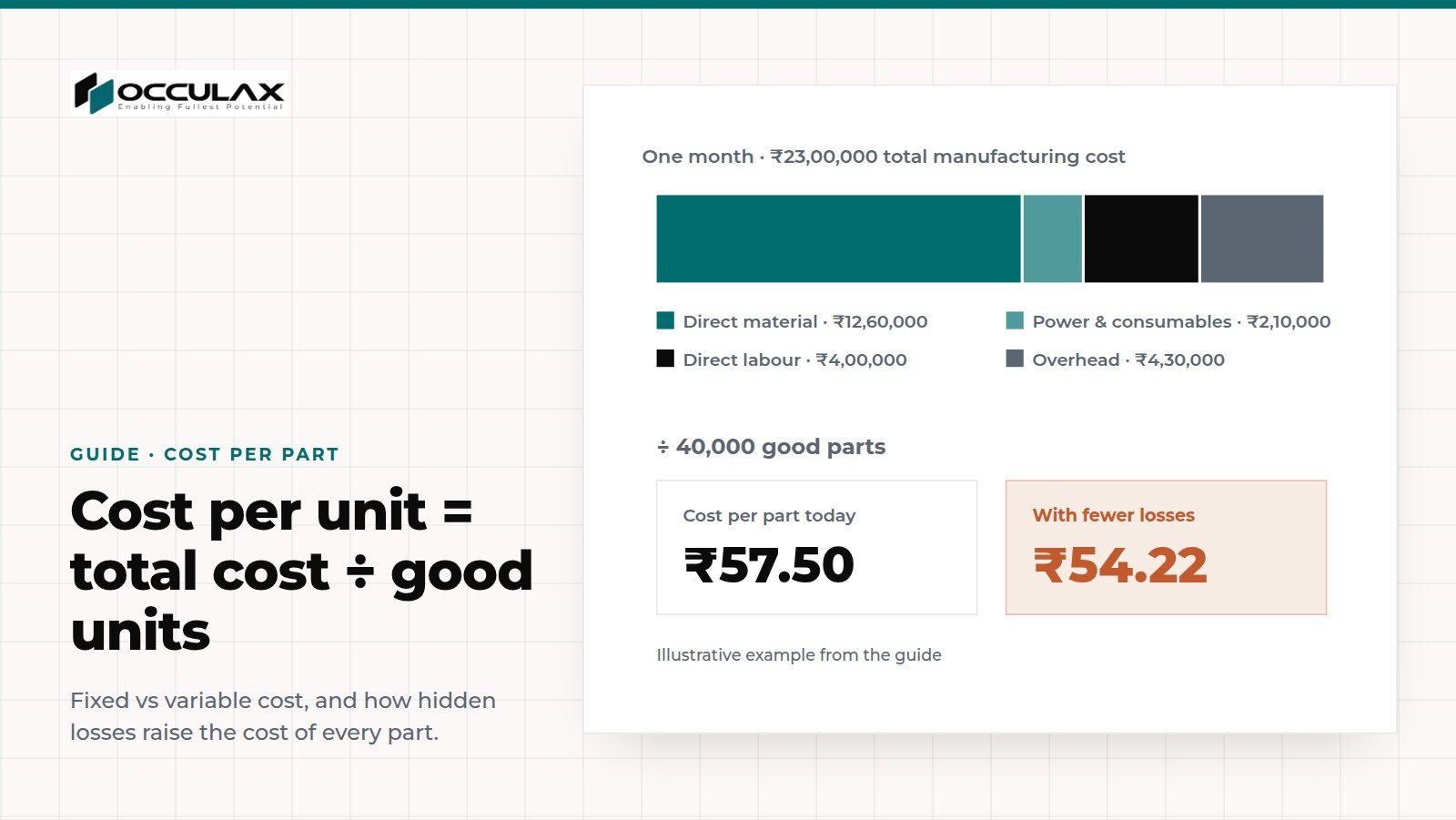
These roll up into one Factory Health Score on your phone, with the rupee impact and the areas to improve. Video stays on-premise through a local gateway, with no external video storage. See how it works or the FAQ. Housekeeping problems often show up first as waiting and work build-up — see how to identify bottlenecks in production — and as hidden cost per part, covered in manufacturing cost per unit.
Frequently asked questions
What are the 5S in a factory?
The 5S are Sort (Seiri), Set in order (Seiton), Shine (Seiso), Standardise (Seiketsu) and Sustain (Shitsuke). Together they keep a work area organised, clean and safe, with a standard that every shift follows.
How do you implement 5S in a factory?
Start with one pilot area and the people who work there. Red-tag and remove what is not needed, give every remaining item a marked place, clean and inspect, write a one-page standard, and audit it weekly with a scored checklist.
What is included in a housekeeping checklist for a factory?
A good checklist covers clear aisles and emergency exits, clean floors with no spills or trip hazards, tools in their places, material and scrap in marked and labelled locations, clean machines with guards in place, and an updated 5S board.
What is a 5S board?
A 5S board is a notice board in the work area showing the area map, standard photo, cleaning schedule, latest audit score and trend, and open actions. It keeps 5S visible so it does not fade after the first cleanup.
How often should a 5S audit be done?
Run a quick housekeeping check every shift, a scored 5S audit every week by the supervisor or a rotating auditor, and a monthly audit by the plant head or another department.
Why does 5S fail in many factories?
It usually fails at Standardise and Sustain: the first cleanup is done, but no routine, owner or regular audit is set up, and management stops asking about it. A weekly score reviewed in production meetings is the simplest fix.
To see how housekeeping, flow and machine time affect your plant together, start a 14-day pilot with the cameras you already have.
- Lean manufacturing
- 5S
- Housekeeping
- Workplace safety
- Shop floor
See your factory's true number
Occulax connects to the cameras you already have and gives you one Factory Health Score — no new hardware, no downtime.