Guide9 min read
Manufacturing Cost per Unit: Formula and Worked Example
Cost per unit = total manufacturing cost ÷ good units produced. Formula, fixed vs variable cost, a worked ₹ example, and how hidden losses raise cost per part.
By Occulax team
On this page
Ask a plant head what a part costs to make and you will often get the costing sheet number — the one prepared when the quote was given. The real number moves every month. It goes up when machines stop, when people wait for material, and when parts are rejected, even though the price of steel and the wage bill stay the same. This guide explains the manufacturing cost per unit formula, the difference between fixed and variable cost per unit, a worked rupee example, and how the hidden losses on the shop floor change what each part really costs.
Quick answer Manufacturing cost per unit = total manufacturing cost ÷ number of good units produced. Total manufacturing cost is direct material + direct labour + manufacturing overhead for the same period. Because labour and overhead are largely fixed each month, every stoppage, idle hour and rejected part raises the cost of each good part, even when material prices do not change.
What is the manufacturing cost per unit formula?
The basic formula is:
Cost per unit = Total manufacturing cost ÷ Good units produced
where:
Total manufacturing cost = Direct material + Direct labour + Manufacturing overhead
Use the same period for both — usually a month — and divide by good units, not total units made. A rejected part used material, machine time and labour, but you cannot sell it. Its cost has to be carried by the good parts.
The three cost elements:
| Element | What it includes | Typical examples |
|---|---|---|
| Direct material | Material that becomes part of the product | Steel sheet, castings, resin, bought-out components |
| Direct labour | Wages of people who work directly on the product | Machine operators, assembly workers |
| Manufacturing overhead | All other factory costs | Supervision, power, maintenance, tooling, consumables, rent, depreciation, quality staff |
Two related terms you will see in costing:
- Prime cost = direct material + direct labour.
- Conversion cost = direct labour + manufacturing overhead — the cost of turning material into a product.
Selling, distribution and head-office costs are not part of manufacturing cost. They are added separately when you work out the total cost to the customer.
What is variable cost per unit?
Costs behave in two ways as volume changes:
- Variable costs rise and fall with the number of parts made: raw material, power used by the machines, consumables, packing.
- Fixed costs stay roughly the same each month whatever you make: salaried staff, rent, depreciation, insurance, most maintenance contracts.
The formulas:
Variable cost per unit = Total variable cost ÷ Units
Fixed cost per unit = Total fixed cost ÷ Units
Cost per unit = Variable cost per unit + Fixed cost per unit
Variable cost per unit stays fairly steady. Fixed cost per unit falls as output rises, because the same monthly fixed cost is spread over more parts. That is why lost production time hurts so much: you pay the full fixed cost and get fewer parts to spread it over.
Note In many Indian plants, direct labour on monthly wages behaves like a fixed cost in the short term — you pay the shift whether the machines run or not. Contract labour paid per piece behaves more like a variable cost. Classify labour the way it is actually paid in your plant.
Worked example: cost per unit of production in ₹
Here is an illustrative example for a small machining plant making one component in a month.
- Parts produced: 42,000
- Parts rejected and scrapped: 2,000
- Good parts: 40,000
- Material: ₹30 per part produced; power and consumables: ₹5 per part produced
| Cost item | Type | Basis | Monthly cost (₹) |
|---|---|---|---|
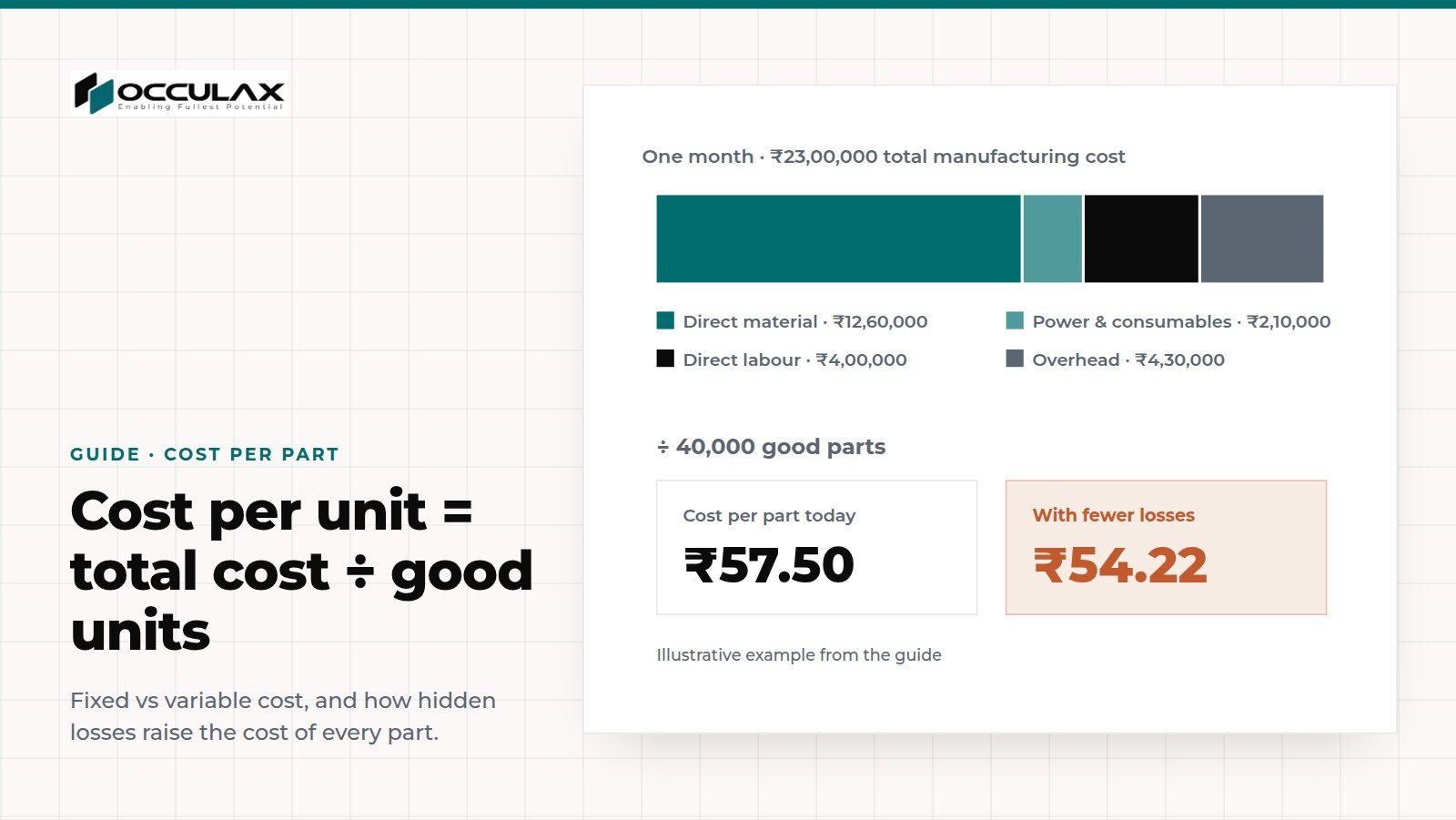
| Direct material | Variable | ₹30 × 42,000 parts produced | 12,60,000 |
| Power and consumables | Variable | ₹5 × 42,000 parts produced | 2,10,000 |
| Direct labour (monthly wages) | Fixed | — | 4,00,000 |
| Factory overhead (supervision, maintenance, rent, depreciation) | Fixed | — | 4,30,000 |
| Total manufacturing cost | 23,00,000 |
Now the per-unit figures, dividing by the 40,000 good parts:
| Measure | Calculation | Per good part (₹) |
|---|---|---|
| Variable cost per unit | 14,70,000 ÷ 40,000 | 36.75 |
| Fixed cost per unit | 8,30,000 ÷ 40,000 | 20.75 |
| Cost per unit | 23,00,000 ÷ 40,000 | 57.50 |
If you had divided by all 42,000 parts produced, you would get about ₹54.76 — a number that looks better but hides the cost of the 2,000 rejects.
Tip Check what your costing sheet divides by. If it uses parts produced, or a theoretical capacity, it will understate what each saleable part really costs.
How do hidden losses raise cost per part?
Most of the gap between what a part should cost and what it actually costs is not in the purchase price of material. It is in time and material lost on the floor.
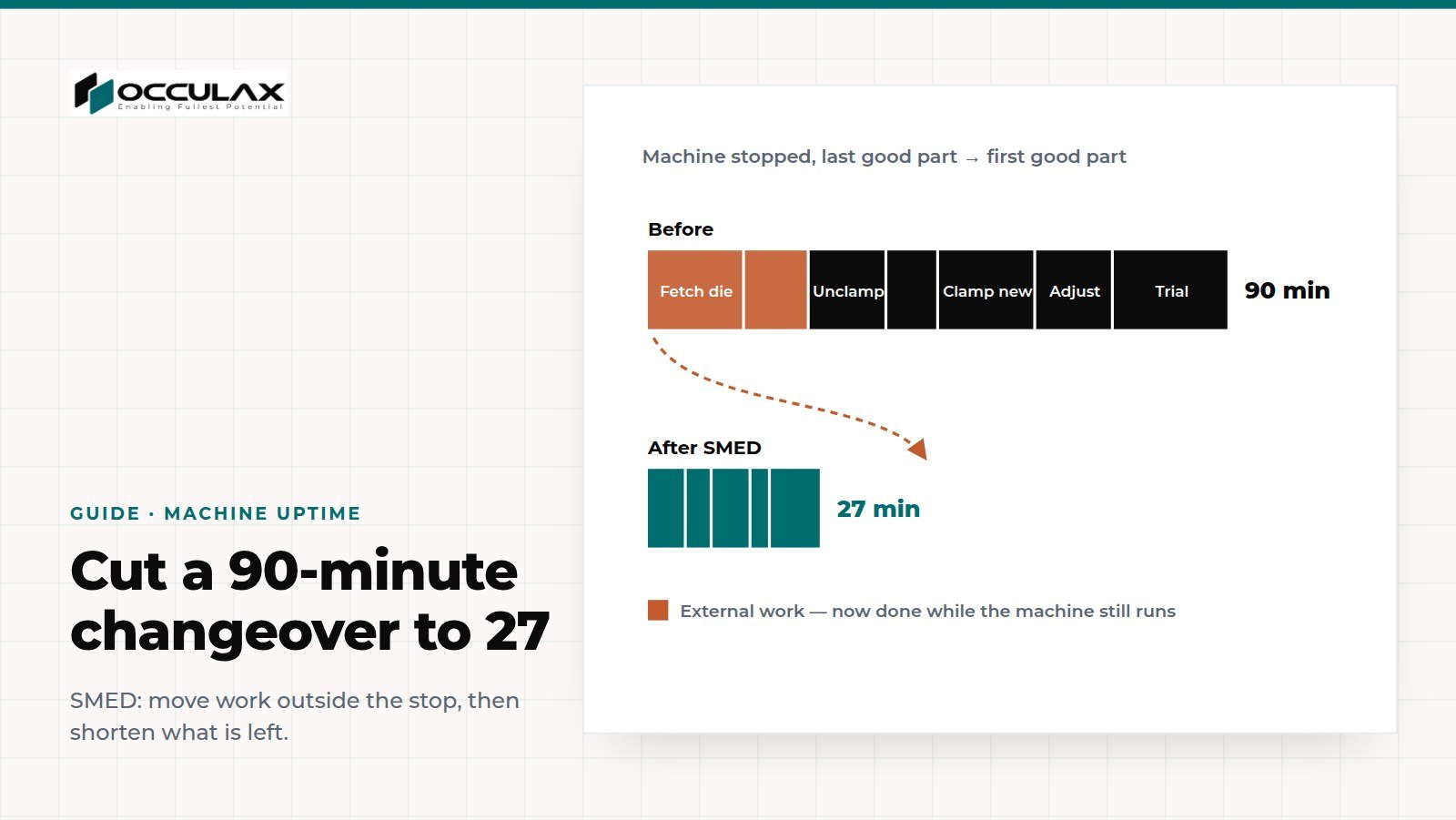
Downtime. When a machine stops for a breakdown, a changeover or a missing tool, labour and overhead keep running. Fewer parts carry the same fixed cost. See how to reduce machine downtime and how to reduce changeover time.
Idle and waiting time. Operators waiting for material, a crane, an inspector or instructions are paid but not producing. In the example above, if one-fifth of paid labour time was spent waiting, about ₹80,000 of the ₹4,00,000 wage bill bought no output.
Bottlenecks and work build-up. If one station is slower than the rest, the whole line runs at its pace. Upstream stations build stock, downstream stations wait. See how to identify bottlenecks in production.
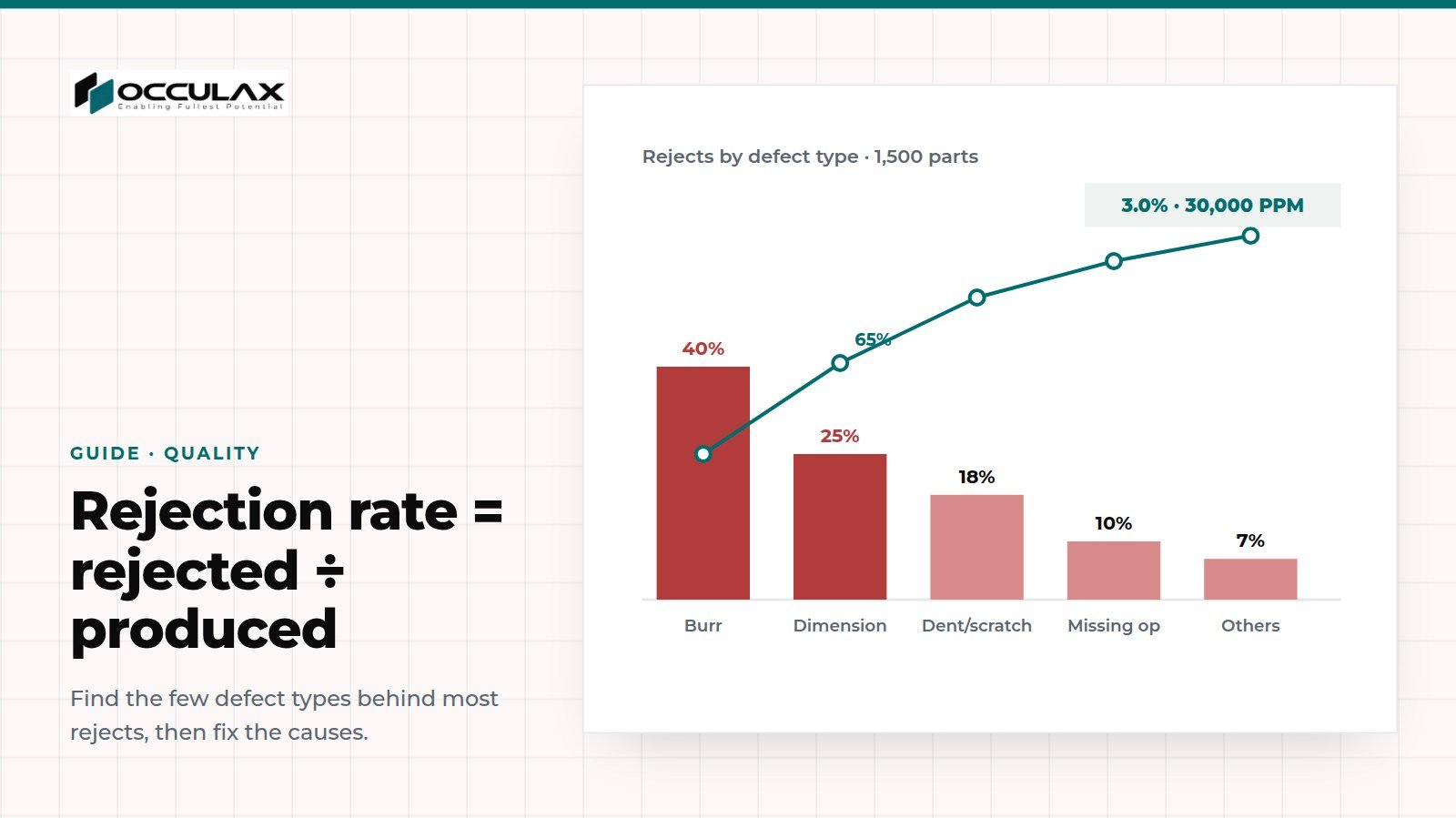
Rejection and rework. Every scrapped part consumed material, power and machine time. In the example, the 2,000 rejects used 2,000 × ₹35 = ₹70,000 of variable cost and produced nothing to sell. Rework adds labour and machine time on top. See how to reduce rejection rate.
Slow running. A machine running below its standard cycle time makes fewer parts per shift, with the same effect as downtime. Compare actual cycle time against takt time — see takt time vs cycle time.
All of these show up together in OEE. How to calculate OEE explains how availability, performance and quality combine.
What happens when losses are recovered?
Continuing the illustrative example: suppose the plant recovers enough lost time to produce 46,000 parts instead of 42,000, and cuts rejects from 2,000 to 1,000, with the same people and machines.
| Current | Losses reduced | |
|---|---|---|
| Parts produced | 42,000 | 46,000 |
| Rejected | 2,000 | 1,000 |
| Good parts | 40,000 | 45,000 |
| Variable cost (₹35 per part produced) | ₹14,70,000 | ₹16,10,000 |
| Fixed cost | ₹8,30,000 | ₹8,30,000 |
| Total manufacturing cost | ₹23,00,000 | ₹24,40,000 |
| Cost per good part | ₹57.50 | ₹54.22 |
Total spend went up by ₹1,40,000 because more material was used, but each good part now costs about ₹3.28 less, and the plant has 5,000 more parts to sell. No price negotiation with suppliers was needed.
How to reduce manufacturing cost per unit
- Measure it honestly. Calculate cost per good unit every month from actual costs and actual good output, not from the costing sheet.
- Find where time is lost. Break the shift into running time, stops, changeovers, waiting and slow running. The largest bucket is the first target.
- Protect the bottleneck. An hour lost at the bottleneck is an hour lost for the whole plant. Make sure it never waits for material, operators or tools.
- Cut changeover time. Use SMED to bring changeovers down, so more of the shift is spent making parts.
- Reduce rejection at source. Use Pareto analysis and root-cause methods to remove the biggest defect types, not just inspect them out.
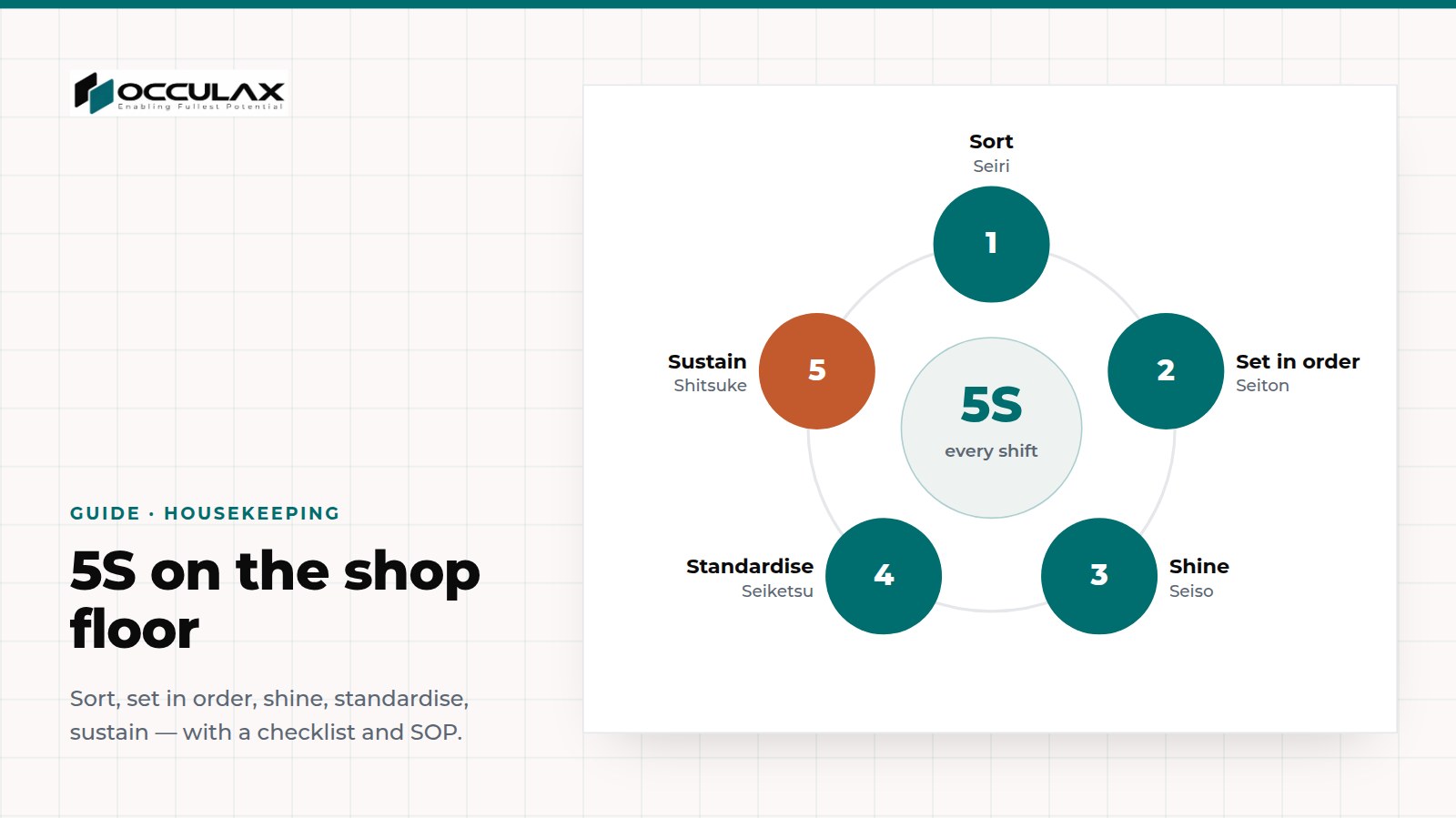
- Fix housekeeping and flow. Clear aisles, marked locations and tools in their place cut searching and waiting. See 5S housekeeping in the factory.
- Then look at material and purchase prices. Material is often the largest cost element, so yield, scrap and buying all matter — but the time losses above are usually the ones nobody is measuring.
Example The useful question is not "what does this part cost?" but "what would it cost if we ran the way we should?" The gap between current and potential cost per part is the size of the prize.
Seeing cost per part with the cameras you already have
The hard part of all this is knowing where time actually goes on the floor. OCCULAX connects to the CCTV cameras a factory already has, through existing RTSP/NVR streams, with no new hardware. It looks at six factory vitals — machine uptime, people (where productive time goes), flow (waiting, bottlenecks and work build-up), quality (visible rejection patterns), safety and housekeeping.
It learns the factory's operating patterns, takt times and standard cycle baselines, and gives one Factory Health Score on your phone with the rupee impact — for example, current versus potential cost per part — and the areas to improve. Video stays on-premise through a local gateway, with no external video storage. See how it works or the FAQ.
Frequently asked questions
How do you calculate manufacturing cost per unit?
Add direct material, direct labour and manufacturing overhead for a period, then divide by the number of good units produced in the same period. For example, ₹23,00,000 ÷ 40,000 good parts = ₹57.50 per part.
What is the cost per unit of production formula?
Cost per unit of production = (total fixed costs + total variable costs) ÷ units produced. Use good, saleable units in the denominator so that the cost of rejected parts is included.
How do you calculate variable cost per unit?
Divide total variable cost — material, power, consumables and other costs that rise with volume — by the number of units. In the example above, ₹14,70,000 ÷ 40,000 = ₹36.75 per good part.
Why does cost per unit go down when production goes up?
Fixed costs such as salaries, rent and depreciation stay the same each month, so making more parts spreads them more thinly. Variable cost per unit stays roughly the same, so total cost per unit falls.
Does rejection increase cost per unit?
Yes. A rejected part consumes material, labour, power and machine time but cannot be sold, so its cost is carried by the good parts. Rework adds further labour and machine time.
What is the difference between prime cost and conversion cost?
Prime cost is direct material plus direct labour. Conversion cost is direct labour plus manufacturing overhead — the cost of converting material into a finished product.
To see your current versus potential cost per part, start a 14-day pilot with the cameras you already have.
- Lean manufacturing
- Cost per unit
- Manufacturing cost
- Cost reduction
- Plant management
See your factory's true number
Occulax connects to the cameras you already have and gives you one Factory Health Score — no new hardware, no downtime.