Guide10 min read
Takt Time vs Cycle Time vs Lead Time: Formulas and Example
Takt time is the pace demand requires; cycle time is how long a step takes; lead time is order to delivery. Formulas, a worked example and line balancing.
By Occulax team
On this page
- What is takt time?
- What is cycle time?
- What is lead time?
- Takt time vs cycle time vs lead time: what is the difference?
- Takt time vs cycle time: a worked example
- How do takt time and cycle time drive line balancing?
- What are the common mistakes with takt and cycle time?
- How can you measure cycle times against takt automatically with your existing cameras?
- Frequently asked questions
Takt time and cycle time are two of the most used — and most mixed-up — numbers in lean manufacturing. One comes from your customer, the other from your shop floor. Put them side by side and you can see at a glance whether a line can meet demand, which station is holding it back, and how many people it really needs.
Quick answer Takt time is the pace you must produce at to meet demand: available production time ÷ customer demand. Cycle time is how long a station or process actually takes to complete one unit. Lead time is the total time from order (or material arrival) to delivery, including all waiting. If any station's cycle time is longer than takt time, the line cannot meet demand.
What is takt time?
Takt comes from the German word for a beat or pulse, as in a conductor's baton. Takt time is the beat your line must keep to produce exactly what customers need in the time you have — no more, no less.
Takt time = Available production time ÷ Customer demand
Available production time is shift time minus planned breaks (lunch, tea, meetings). Use the same period for both: minutes per day with units per day, or seconds per shift with units per shift.
Takt time is set by demand. You cannot "improve" it on the floor — it changes only when demand or available time changes.
What is cycle time?
Cycle time is how long it actually takes to complete one unit at a station or through a process step, measured from the start of one unit to the start of the next.
Cycle time = Net production time ÷ Units produced
Or, more practically, time it with a stopwatch over many cycles and take the typical value. Cycle time is set by your process: the machine, the method, the operator and the layout. Unlike takt, it is yours to improve.
Note "Cycle time" is used loosely. Some people mean machine cycle time (one machine cycle), some mean operator cycle time (one operator's full loop of tasks), and some use it for the time an order takes to go through the whole plant. Agree on one definition before comparing numbers.
What is lead time?
Lead time is the total elapsed time from when an order is received (or raw material arrives) to when the finished product reaches the customer. It includes processing time, but also every queue, batch wait, inspection hold and day in a warehouse.
In most plants, the time a part is actually being worked on is a small share of its lead time; the rest is waiting. A simple way to estimate lead time is Little's Law:
Lead time = Work-in-progress ÷ Throughput
For example, a plant holding 7,200 units of work-in-progress and shipping 1,200 units a day has a lead time of 7,200 ÷ 1,200 = 6 days, even if each unit only spends a few minutes on machines.
Takt time vs cycle time vs lead time: what is the difference?
| Takt time | Cycle time | Lead time | |
|---|---|---|---|
| Question it answers | How fast must we produce? | How fast do we produce? | How long does the customer wait? |
| Set by | Customer demand and available time | Process, machine, method, people | The whole flow, including waiting |
| Formula | Available time ÷ Demand | Net production time ÷ Units produced | Work-in-progress ÷ Throughput (Little's Law) |
| Typical unit | Seconds or minutes per unit | Seconds or minutes per unit | Hours or days |
| Can the floor improve it? | No — it is a target | Yes | Yes, mostly by cutting queues and batch sizes |
| Used for | Pacing, staffing, line design | Finding slow steps, line balancing | Delivery promises, inventory planning |
The relationship to remember: if cycle time > takt time at any station, you will fall behind demand and need overtime. If cycle time is well below takt everywhere, you have more people or machines on the line than demand needs.
Takt time vs cycle time: a worked example
An assembly line runs two shifts. Illustrative numbers:
- Each shift: 480 minutes, minus 30 minutes lunch and two 10-minute tea breaks = 430 minutes
- Two shifts: 860 minutes = 51,600 seconds a day
- Customer demand: 1,200 units a day
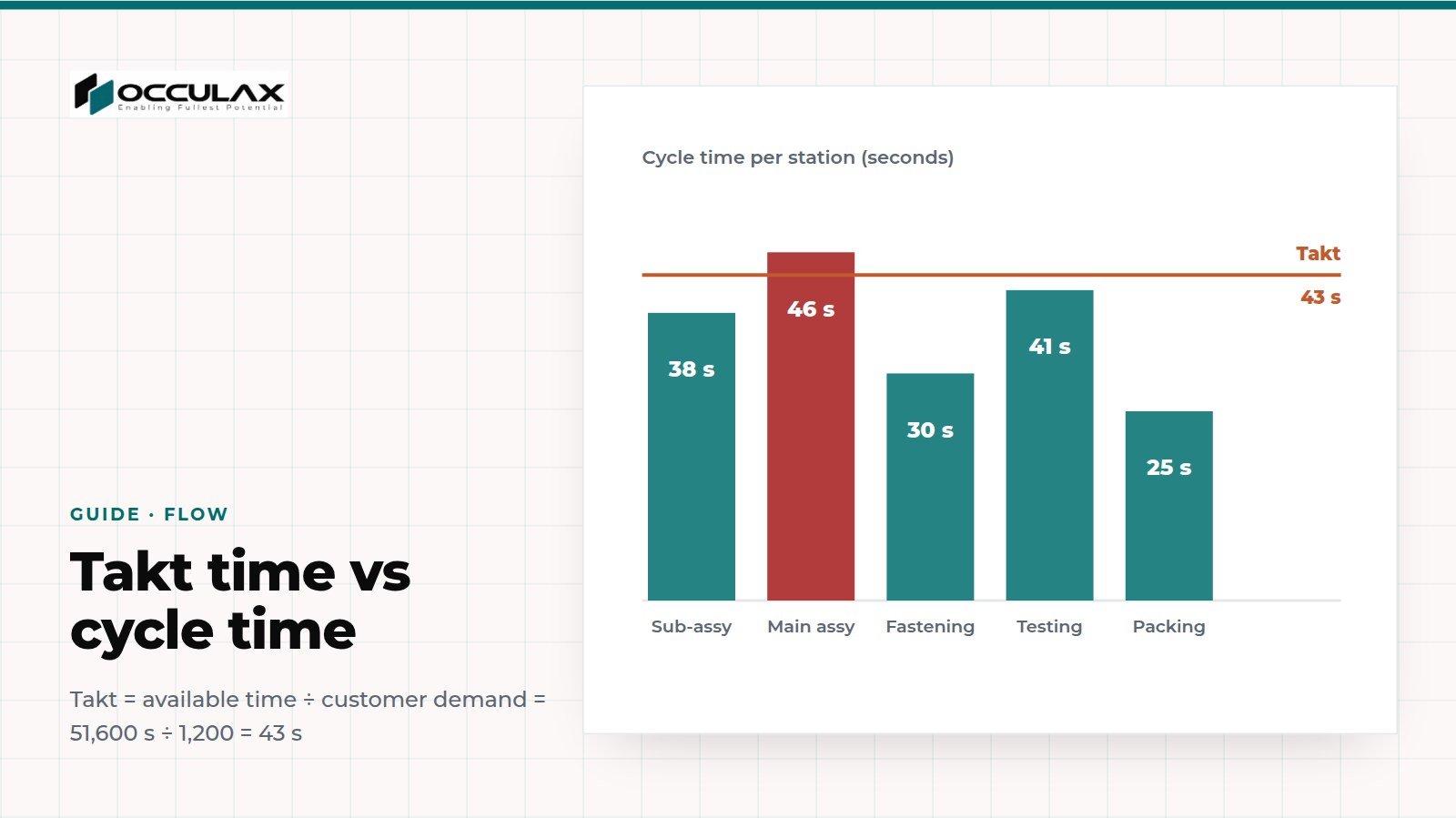
Takt time = 51,600 ÷ 1,200 = 43 seconds per unit
The line has five stations. Their measured cycle times are:
| Station | Cycle time | Against takt (43 s) |
|---|---|---|
| 1. Sub-assembly | 38 s | 5 s under |
| 2. Main assembly | 46 s | 3 s over |
| 3. Fastening | 30 s | 13 s under |
| 4. Testing | 41 s | 2 s under |
| 5. Packing | 25 s | 18 s under |
| Total work content | 180 s |
Station 2 is slower than takt, so it is the bottleneck and sets the pace for the whole line. At 46 seconds a unit, the line can make at most 51,600 ÷ 46 = 1,121 units a day — 79 short of demand, every day.
Example If each unit contributes ₹400, the 79-unit shortfall is worth about ₹31,600 a day. The usual response is overtime at station 2 — which costs money and does not fix anything.
For more on finding the slowest step on a real line, see how to identify bottlenecks in production.
How do takt time and cycle time drive line balancing?
Line balancing means spreading the work across stations so each one's cycle time is as close as possible to — but not above — takt time. Three calculations do most of the work.
1. Minimum number of stations (or operators)
Minimum stations = Total work content ÷ Takt time, rounded up
Here, 180 ÷ 43 = 4.19, so at least 5 stations are needed. Four stations would need an average of 45 seconds each, which is over takt.
2. Line balance efficiency
Balance efficiency = Total work content ÷ (Number of stations × Longest cycle time)
Today: 180 ÷ (5 × 46) = 180 ÷ 230 = 78.3%. The other 50 seconds per cycle (230 − 180) is waiting time spread across the faster stations.
3. Rebalance
Look for a task at the slow station that can move to a station with spare time. Suppose a 4-second labelling task moves from station 2 to station 5:
| Station | Before | After |
|---|---|---|
| 1. Sub-assembly | 38 s | 38 s |
| 2. Main assembly | 46 s | 42 s |
| 3. Fastening | 30 s | 30 s |
| 4. Testing | 41 s | 41 s |
| 5. Packing | 25 s | 29 s |
| Total work content | 180 s | 180 s |
| Longest cycle time | 46 s | 42 s |
| Capacity per day | 1,121 units | 1,228 units |
| Balance efficiency | 78.3% | 85.7% |
Every station is now at or under takt. The line can make 51,600 ÷ 42 = 1,228 units a day, comfortably above the 1,200 demanded, with the same people and no new equipment. Balance efficiency rises to 180 ÷ (5 × 42) = 85.7%.
Tip Do not balance every station to exactly 43 seconds. Real cycle times vary from unit to unit, and a station planned at 100% of takt will fall behind every time something goes slightly wrong. Many lean practitioners plan stations somewhat below takt to leave room for that variation.
Other ways to bring a slow station under takt:
- Remove waste from its work: walking, searching, reaching, waiting for a tool. A well-organised workstation helps — see 5S housekeeping in a factory.
- Cut its downtime and changeovers, since a station that stops loses cycles. See how to reduce machine downtime and how to reduce changeover time with SMED.
- Split the station into two, if the work content allows it.
- Reduce rework, because a unit done twice takes two cycles.
What are the common mistakes with takt and cycle time?
- Using total shift time for takt. Take breaks out first, or takt will look longer than it really is.
- Using design cycle times. Measure on the floor, over many cycles and both shifts. The engineering standard and the real time often differ.
- Ignoring downtime. A station with a 40-second cycle that stops for an hour a shift does not deliver a 40-second pace. Compare takt with effective cycle time, after stops.
- Recalculating takt too rarely. When demand changes, takt changes, and so does the right number of people on the line.
- Confusing cycle time with lead time. Cutting a machine's cycle time by 5 seconds does little for a customer waiting six days because parts sit in queues.
Better takt and cycle time data also sharpens your costing; see manufacturing cost per unit and how to calculate OEE.
How can you measure cycle times against takt automatically with your existing cameras?
Stopwatch studies take time, cover a few hours at best and tend to capture the line on its best behaviour. Continuous measurement shows how cycle times really vary across shifts, operators and product mix.
OCCULAX uses the CCTV cameras already installed in your factory, connecting to existing RTSP or NVR streams with no new hardware. It learns your factory's operating patterns, takt times and standard cycle baselines, and tracks six vitals — machine uptime, people, flow, quality, safety and housekeeping. You get one Factory Health Score with rupee impact and areas to improve, on your phone. Video stays on an on-premise gateway, with zero external video storage. See how it works or the FAQ.
Frequently asked questions
What is the formula for takt time?
Takt time = available production time ÷ customer demand. For example, 51,600 seconds of available time a day and demand of 1,200 units gives a takt time of 43 seconds.
What is the difference between takt time and cycle time?
Takt time is the pace demand requires; cycle time is the pace your process actually achieves. If a station's cycle time is longer than takt, the line cannot keep up with demand.
What is the difference between cycle time and lead time?
Cycle time is how long one step takes to complete a unit. Lead time is the total time from order or material arrival to delivery, including all waiting, and is usually far longer.
Can cycle time be less than takt time?
Yes, and it should be, slightly, at every station. If it is far below takt everywhere, the line has more capacity or people than demand needs and can be rebalanced with fewer stations.
How do you calculate the number of operators needed using takt time?
Divide the total work content by takt time and round up. For example, 180 seconds of work at a 43-second takt needs at least 5 operators or stations.
What is line balancing in manufacturing?
Line balancing is distributing work across stations so each one's cycle time is close to, but not above, takt time. It raises output and reduces idle time without adding people or machines.
Want to see real cycle times against takt across every shift? Start a 14-day pilot — no hardware and no downtime.
- Takt time
- Cycle time
- Lead time
- Line balancing
- Lean manufacturing
See your factory's true number
Occulax connects to the cameras you already have and gives you one Factory Health Score — no new hardware, no downtime.